
Following on from our day celebrating Word Naked Gardening Day we took time to take a look at our garden and ways in which to make it more private, enabling us to enjoy more of our outdoor space without upsetting our neighbours.
First things first, we realised that we’re very fortunate that there are a number of mature trees, either in our garden or close to the boundary line between properties. These include two oak trees, a silver birch, apple trees, hazel and a spring flowering cherry tree. All of these, once the leaves are out, shield us from the upper windows of our neighbours houses, in a large proportion of our garden and most of the patio area next to our house.
Next, we considered how in these areas, how best to screen from anyone in neighbouring gardens. Our garden is largely bordered by brick walls of varying heights which provides a solid base to which we attached a variety of trellising and wire. Nothing too intrusive or imposing, but enabling us to train a range of climbing plants.
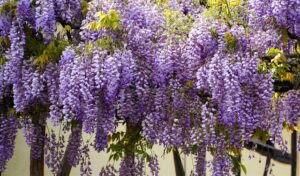
On one side of the garden, we already had an established Wisteria, which looks fabulous around April and May and also has the benefit of being fast growing and easy to train around the walls providing leaf cover throughout the summer months.
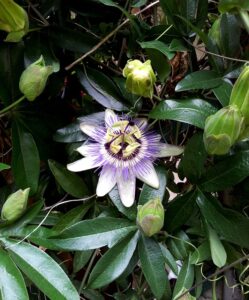
Another fast growing climbing plant is passionflower, which has spread naturally around the trellis and long the wiring combining well with the wisteria and displaying exotic looking flowers which attract a multitude of bees.
The wisteria and passionflower growing along one boundary wall has proven not just a great visual barrier, but also an improved physical barrier for wayward footballs from the children in next-door’s garden.
On the opposite border, sits our flowering cherry which not only provides a wonderful display of pale pink blossom in early spring, but once the blossom has gone, the leaf cover shield us from the upstairs window of our neighbour’s house.
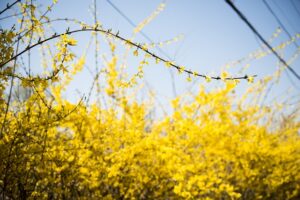
Adjacent to the cherry tree we have a forsythia bush. This too has an impressive display of spring time flowers and is often one of the first plants to flower each year. It’s bright yellow flowers arriving at a similar time to the daffodils. Forsythia too is a fast grower. It can be pruned hard immediately after flowering, but soon sends out new shoots which can add 6-8 feet of height and some of the vertical shoots can be trained sideways to screen more of the boundary. Pruning early in the season, should allow the new shoots to mature over the summer months and produce new flowers in the following spring.
We have a variety of other smaller plants which we have used to good effect, including a rosemary hedge, a bay tree, hibiscus and banana, contained in pots, which we can move around to plug a gap. These can also be placed on top of other sturdy items to add additional height.
We’re now confident that our neighbours would not catch sight of anything that might cause them offence and as an unexpected bonus, we’ve realised that the level of bird-life has increased dramatically now that the birds have additional places to hide and to roost.
Leave a Reply